Is a 3D Nail Printer Worth It for Your Nail Salon? Function, Costs, Practice
In this article
3D nail printers keep popping up in reels and ads – with the promise of putting any motif on the nail in seconds. For salon owners, the sober question is: is this a genuine tool for everyday work or just a gimmick? This guide explains, without the marketing gloss, how the technology works, what it costs and when the investment pays off.
How does a 3D nail printer work?
Put simply, a nail printer is a specialised inkjet printer for the nail surface. You place the finger inside (or a tip into the holder), choose a motif on the display or in the app, and the device transfers it in a single pass. The motif is then sealed with a top coat. Some models only print flat colour and photo motifs, others advertise finer detail. The term “3D” here usually means designs that look three-dimensional, not actually building up material – that’s still the job of your gel or acrylic.
Natural nail, tip or press-on?
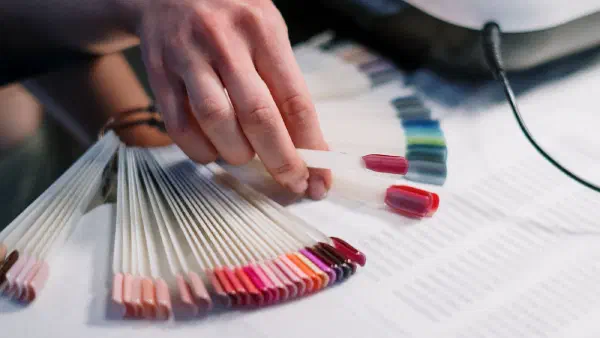
Not every printer likes every surface. Many devices deliver the cleanest result on smooth tips or press-on nails, because the surface is even and easy to fix in place. It works on the natural nail too, but that requires a smooth base. This matters for the salon workflow: if you print onto pre-made tips, you can even prepare designs while the client is still having her manicure.
Speed & practice in everyday salon work
The advertised “a few seconds per nail” holds true for the printing process itself – but an honest look counts the whole workflow: prep, base, print, sealing, curing. Realistically, you save time above all on elaborate, intricate or recurring designs that you would otherwise paint freehand for minutes. For a simple single-colour manicure, by contrast, the printer brings little benefit.
What does a nail printer cost – purchase and follow-up costs
The devices in our 3D nail printer comparison cover a broad price range – from cheap entry-level models to pricier printers marketed as “pro”. On top of the purchase come running costs:
- Consumables (device-specific ink/cartridges)
- Base and top coat for adhesion and durability
- Tips or press-on nails, if you don’t print onto the natural nail
- possibly spare parts – an uncertainty factor with no-name devices
Does it pay off for the salon?
A rough rule of thumb: the printer is worth it if it noticeably saves time per application and you convert that time into additional appointments or a design surcharge. Sample calculation (simplified): if you save an average of 15 minutes on elaborate designs and offer such sets several times a week, it quickly adds up to several hours a month – time that can recoup an entry-level printer within a few weeks to months. If, on the other hand, you almost only do plain manicures, the printer remains more of a toy.
Limits – what you realistically need to watch for
- Quality varies: especially with cheap devices, print quality and durability don’t always match hand work. Reading reviews pays off.
- No substitute for skill: prep, shape and sealing still decide the result – just as with classic nail art.
- Hygiene: in the salon the device has to be quick to clean.
- Trend risk: calculate conservatively rather than betting on a short-lived nail trend.
Conclusion
A 3D nail printer is no miracle machine, but a sensible time-saver for salons that regularly offer elaborate or recurring designs. Anyone who does a lot of classic manicures doesn’t need one. If you’re toying with the idea, our 3D nail printer comparison will help you pick the right model.
Frequently Asked Questions (FAQ)
Is a 3D nail printer hard to use? The basic operation is usually simple, but you’ll still need a little practice to get going. Plan a few trial runs on tips before you use the device at the client’s chair.
Can I print my own designs or my salon logo? With many app-enabled devices, yes – you upload images or logos and print them onto the nail. When buying, look for an upload function if that matters to you.
Does the printer replace my nail designer? No. The printer handles the motif, not the prep, shaping and consultation. It’s a tool that makes good work faster – not a substitute for professional skill.